
Written by Anna Cen
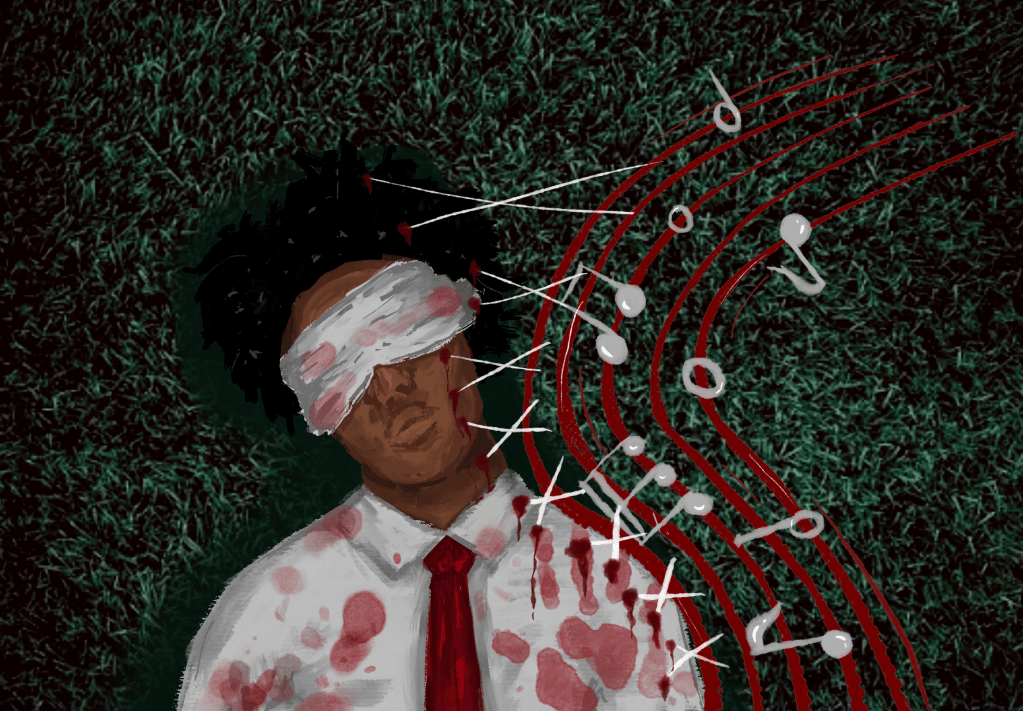
When 20-year-old David Anthony Burke, a beloved singer and songwriter better known as D4vd, was suggested to be romantically involved with and worse, accused of having murdered 13-year-old Celeste Rivas Hernandez, fans were quick to display their outrage, while others responded in defense of the artist. Yet, D4vd is not the first well-respected and beloved singer who raised this kind of dilemma. The situation reignites the long-debated question: should we separate the art from the artist?
While some may argue that listening to an immoral person’s music is unethical, others counter that art should be appreciated as a separate, stand-alone medium. Another famous musical artist whose fans face this dilemma is Kanye West, a celebrated artist who is often viewed as a “musical genius.” With hit songs like “Runaway” and “Violent Crimes,” it is undeniable that he is not only an impactful and passionate artist but also one whose music is often centered around societal issues. However, Kanye’s actions don’t always reflect his art. While his music expresses his concerns regarding hatred and targeted violence in society, his behavior not only doesn’t display this same concern, but also contributes to these social issues. In recent years, he has frequently expressed antisemitic and neo-Nazi views, causing many of his fans to question whether or not they should still be listening to his music. Other hit artists also known for their dishonorable character though impactful art include P. Diddy and R. Kelly, and, outside of the music scene, painter Pablo Picasso and author J.K. Rowling.
But rather than thinking whether or not we should be separating the art from the artists, we should start by asking whether it’s possible at all. One issue is that art often are extensions of an artist’s identity and perspective. If the context and inspiration is not fully understood by listeners, listeners may misinterpret the true meaning of the piece. Art is more than just the piece itself — it embodies a story. It is impossible, and even dangerous, to interpret a piece of art separate from the artist, because doing so removes an entire facet of the artwork’s meaning. This leads to misinterpretation and a shallow understanding of the art.
What we can do instead is consider whether it is moral to support an unlawful person’s art. Artists get paid based on the amount of engagement they receive, or in a singer’s case, the number of music streams they get. Thus, consuming an artist’s work would be an automatic — however intentional — form of support. Additionally, consuming an artist’s work is a sign of appreciation. In listening to a singer’s music, the listener is sending the message that their art is appreciated, further motivating them to keep producing works and showing that the artist still holds public approval.
If an individual believes that an artist’s character is immoral, then continuing to stream their music as if nothing changed would not just be unethical, but a form of enabling their behavior. Not only are you sending an indirect message saying “we’re okay with these actions,” but it may also be seen as encouragement to continue doing exactly what they did.
Although it is important not to enable such artists, we should also recognize the impact of the work and acknowledge the meaning behind it. In an unreleased song called “Pray,” celebrated rapper Kendrick Lamar made the following remarks on the nature of talent, arguing that yes, art can be separated from the artists: “I got a theory that most of y’all won’t allow to see // It goes like this, talent doesn’t choose morality // See, if Daniel Hale was a killer, would you not want a heart? // If Carl Benz was a racist, would you stop driving cars? // I can’t help we jump in these bodies and you called them a God // Just know the Earth is just a rock without the voices of art, sincerely yours”. Kendrick challenges the idea that morality overshadows the impact one makes, arguing that while individuals have scattered moralities of good or evil, talent is key to creating a lasting impact on the world. As an artist, he also claims that art is what shapes the world and gives it meaning, not the people behind it.
But ultimately, Kendrick’s statements are a reminder that we have the power (but also responsibility) to not enable unlawful people. While observing and interpreting music as an introspective view of human actions and consequences is valid, we must take action upon recognizing an artist’s character.
In order to prevent the support of such artists, the quick and optimal solution is to simply stop streaming their music to best show disapproval and effectively stop them from continuing or repeating their actions. Although this will feel like a sacrifice one has to make, you must realize this situation is larger than you: individuals who commit faulty actions must face adequate consequences in order to prevent the normalization of such negative actions. Art can be powerful and compelling regardless of morality, but it’s our responsibility to draw the line, to prevent the amplification of these poor actions across society.


 Teens of Bay Area
Leave a comment